Textural Décor: Choosing Texture Before Color
Tadelakt, travertine, marble — three materials that stop the eye. Not through their color. Through their texture.
In a space that's too smooth, the eye never stops anywhere. It slides. Surfaces follow one another without resistance, without catching, as if nothing truly deserved to be looked at. That's where textural décor changes everything.
It's neither the color nor the shape that create presence, but the texture. An imperfect, dense, living surface. Something that holds the light instead of reflecting it. A material that forces you to slow down. To look. To feel. And suddenly, the space truly exists.
Tadelakt: The Material That Absorbs Light
Lime, water, stone, olive oil — and the hand's gesture
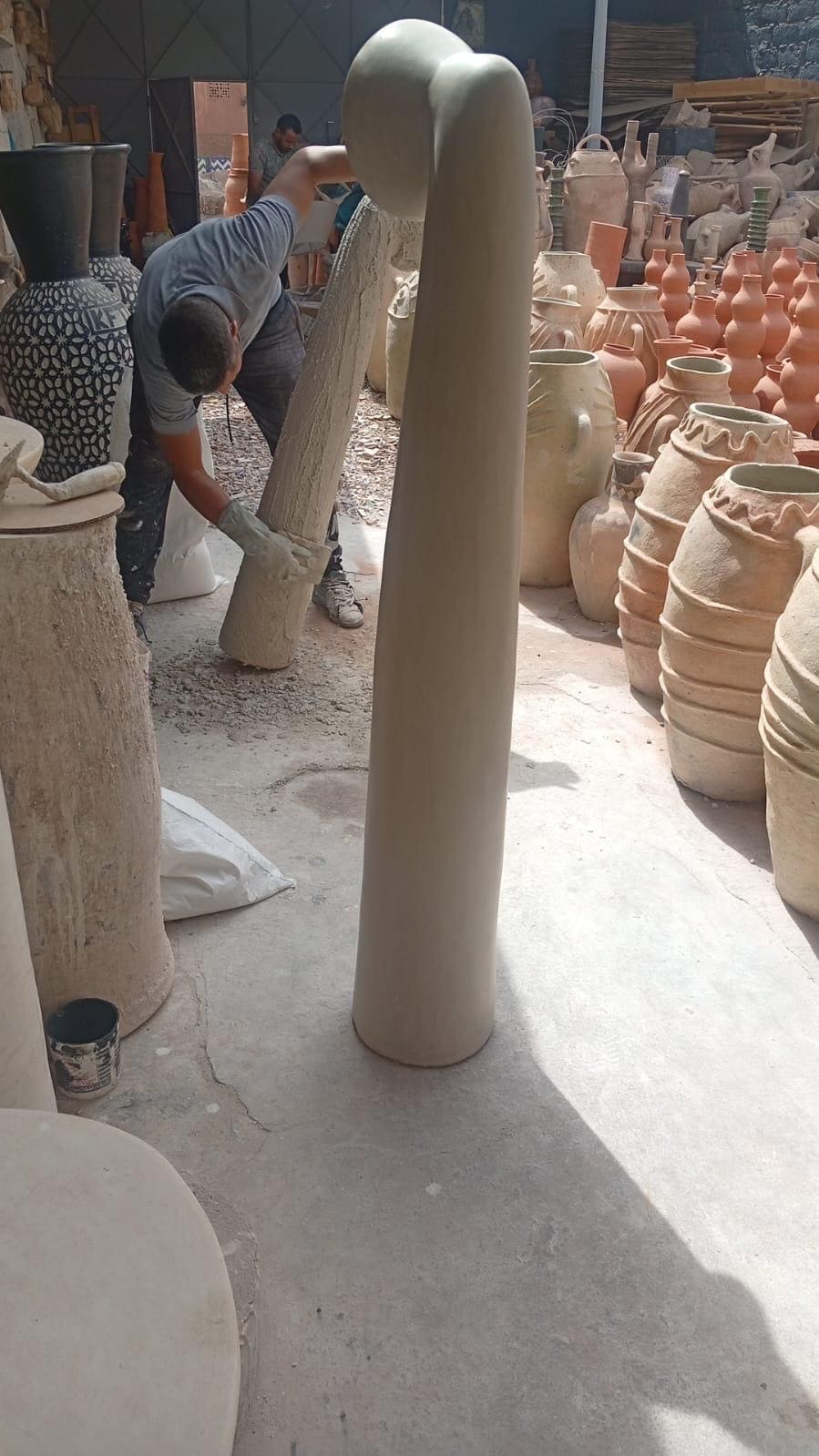
The tadelakt decor isn't a finish. It's a natural plaster that keeps the memory of the hand that worked it. Lime, water, stone, olive oil. Nothing more. But everything happens in the gesture.
In Abdel's workshop, every surface is worked slowly. Pressure after pressure. The movement doesn't seek perfection, it seeks balance. The result: a material that's neither smooth nor rough. A slightly undulating skin, almost organic.
Light doesn't bounce off it. It sinks in. It softens. It fades a little to better reveal the depth.
Tadelakt doesn't grab attention through effect, but through presence. A surface that lives with the light instead of enduring it.
On our Helix lamps, tadelakt is applied by hand to the structure. Each lamp comes out different — more matte, more silky, deeper depending on the pressure and temperature of the moment. This isn't a manufacturing flaw. It's the signature of the gesture.
At the showroom, you understand it immediately through touch. That slightly resistant softness. That impression that the surface is breathing.


The Helix tadelakt lamps are only visible at the showroom by appointment. Some materials can't be understood on a screen. This is one of them.
Travertine: The Stone That Carries Time
Thousands of years of geology, revealed through polishing
The textural travertine doesn't cheat. What you see is what formed thousands of years ago. Its pores, its cavities, its irregularities aren't flaws. They're traces. Marks left by water, mineral deposits, time.
When you choose a piece of natural stone décor, you're not simply buying a material. You're taking a fragment of geology. A cross-section of the earth's history.
Polishing doesn't erase anything. It reveals the density. It opens the stone. Every piece is different. Warmer, cooler. Denser, more porous. Nothing repeats.
And that's precisely where travertine goes beyond the decorative. It doesn't create a "textural effect." It is the material. Full, imperfect, living. And above all, impossible to reproduce.
To go further on travertine in an interior, our Poetic Brutalism explores its different presences.
Marble: The Tension Between Coldness and Presence
A unique vein, a mineral authority

The contemporary marble décor calls for restraint. Too present, it overwhelms. Well placed, it creates a tension.
Gold Arabescato marble, with its warm tones and its almost flowing veins, doesn't settle for being beautiful. It tells a story. A circulation within the stone. A frozen energy.
Its color isn't uniform. It shifts between golden tones, cream, sometimes deeper hues. Nothing flat. Nothing neutral.
To the touch, it's cold. Visually, it's dense. And it's this contrast that works. In a pared-back space, it comes to break up the ambient softness. It creates an anchor point.
At the showroom, you understand it immediately. Marble doesn't try to seduce. It imposes a rhythm. A clear presence. Almost mineral in its authority.
How to Combine Materials Without Overloading
Hierarchy, tension, breathing room
The problem is never the material. It's the excess.
A textural décor that's well thought out relies on a clear hierarchy. One strong material. The others accompanying it. A tadelakt wall. A travertine floor. A marble piece. And around it, calm. Raw wood. Linen. Some artisan ceramic piece.
Multiplying strong textures doesn't create richness. It creates noise. What works is the tension between materials. The dialogue. One surface that absorbs, another that captures, another that structures.
You have to leave space. Let the material breathe. Otherwise, it loses everything that gives it strength. Our article on sustainable décor explores this logic of thoughtful choices in more depth.
3 Rules for Successful Textural Décor
- One strong material, the others supporting it — no competition between textures.
- Leave space around it — the material loses its strength when it's drowned out by accumulation.
- Favor dialogue — one surface that absorbs, another that captures, another that structures.
Genuine Materials, Sustainable Interiors
Natural materials don't follow trends. They pass through them without holding on. They change over time. They mark, patina, and grow denser. Where artificial surfaces age poorly, they gain presence.
Choosing a genuine material isn't an aesthetic choice. It's accepting that the space evolves. Slowly. Naturally. Our guide to natural materials explores how these materials interact within a contemporary interior.
Texture does what color never can. It gives a place weight. Not visually. Physically. An imperfect surface says something smooth refuses to say: here, someone chose. Not the easiest option. The right one.
Maison Dar Anwar
Genuine materials · free spirit