Handmade Artisan Ceramics: What Industrial Production Can't Replicate
Living glaze, hand-thrown, traceability — three differences you sense before you even see them.
You feel it immediately, without needing to compare for long. A handmade artisan ceramic doesn't respond the way an industrial piece does. It has a slightly unpredictable weight, a less obvious grip, almost more honest.
Under the fingers, the surface is never fully uniform. It barely catches, it lives. It's not a question of perfection, but of presence. Where industrial production tries to disappear behind function, the handmade piece asserts itself quietly. And it's precisely that gap that changes everything.
What the hand changes in the material
The gesture written into the wall
In a hand-thrown ceramic, the potter's gesture never fully disappears. It stays imprinted in the wall, visible in slight variations of thickness, in barely perceptible lines left by the wheel. A handmade pottery isn't perfectly symmetrical — and that's precisely its truth.
Industrial production, on the other hand, corrects. It smooths, it standardises, it erases. It wants an object with no apparent history. The hand does the opposite: it lets something through. A tension, a rhythm, sometimes even a controlled hesitation.
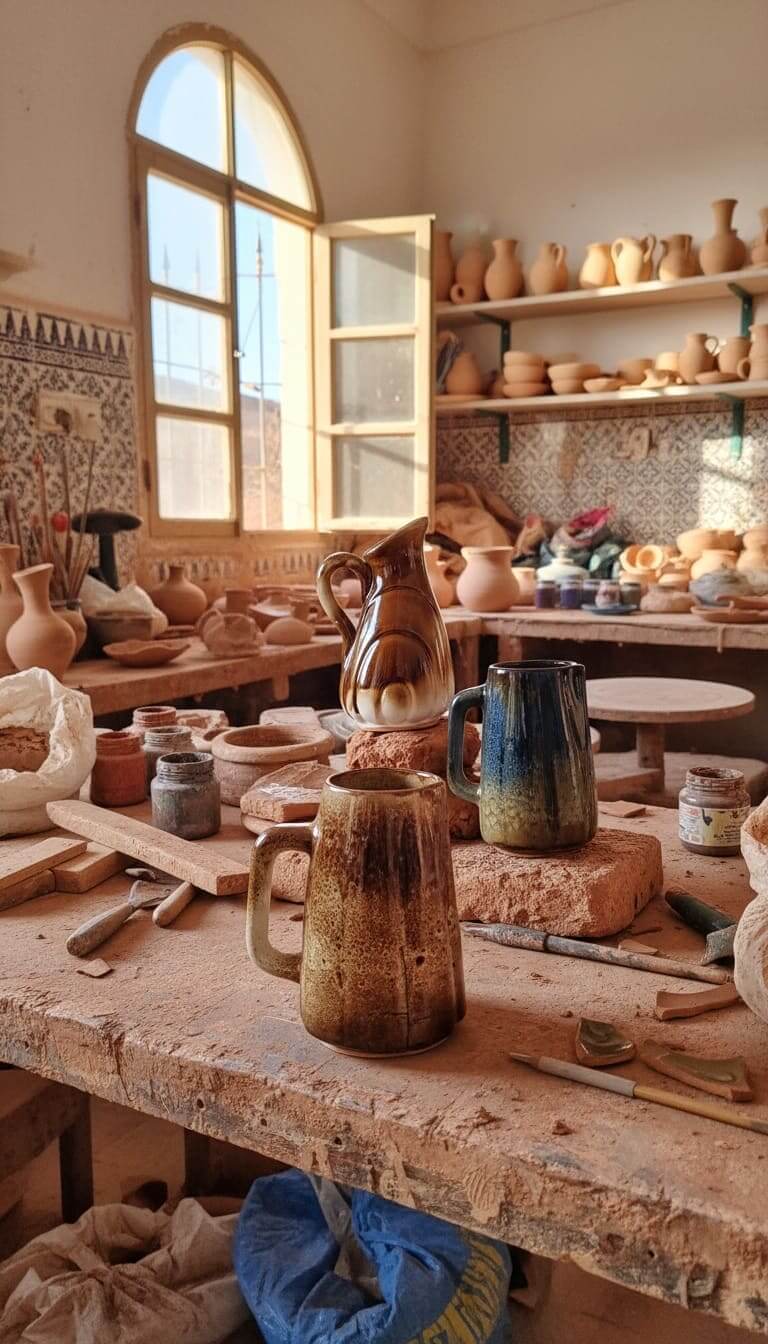
At Rachid's, you can see it without effort. Hands that have never botched a cup. In his workshop in southern Morocco, no website, no Instagram. Just raw clay, thrown by hand, air-dried. His cups hold their warmth longer. They carry fingerprints — not like a flaw. Like a signature.
The Glaze: Where Everything Is Decided
Fire has the final say
This is often where the difference becomes obvious. An artisanal glaze doesn't cover the surface uniformly. It lives. It flows slightly, thickens in places, retreats elsewhere. On a handmade ceramic piece, firing transforms those variations into nuances that never repeat.
In the workshops, no one tries to control every detail. The fire decides part of the outcome. Temperature, placement in the kiln, the glaze's reaction — it all plays a role. Two pieces side by side can come out different, even if they came from the same firing batch.
At Azzedine's, it's almost a rule. The gestures have been passed down for generations. You don't force the material, you let it react. Each piece passes through the fire and comes out with its own response. Sometimes more matte, sometimes glossier. Sometimes darker, sometimes brighter.
This is where industrial production doesn't follow. It stabilises. It neutralises. It repeats. The artisan, on the other hand, accepts that the material has the final say.
Artisan vs. Industrial Ceramics: The Concrete Differences
Three points that really change things
Comparing artisan ceramics vs. industrial ceramics, isn't about pitting two abstract worlds against each other. It's about looking at what actually changes.
The weight, first. A hand-thrown piece doesn't aim for perfect balance. It has a slight variation, a presence. You feel it. It doesn't disappear into the hand.
Durability, next. A artisan ceramic piece well-fired holds up over time. The glaze, worked at high temperature, fuses with the material. It doesn't chip away like a simple applied coating. It ages, but it doesn't degrade the same way.
And then there's traceability. With a cup by Rachid, you know where it came from. The same goes for a dish by Azzedine. You can almost picture the workshop, the earth, the kiln. Industrial production, by contrast, makes objects with no perceptible origin. Functional, yes. But anonymous.
To dive deeper into natural materials and how they play off each other in an interior, our guide to natural materials explores these pairings in detail.
The 3 Differences to Remember
- Weight and grip — a slight irregularity that says nothing was made quickly.
- Living glaze — nuances that shift with the light, never identical from one piece to the next.
- Traceability — you know who made the piece, how, with what clay.
How to Recognise a Genuine Handmade Ceramic Piece
What you see when you take your time looking
Just take your time looking. The base, often, isn't fully glazed. It can be slightly rough, almost raw. That's normal. It's even a good sign.
Inside, you can catch a glimpse of the throwing marks. Fine, discreet lines that tell of the hand's passage. The glaze, meanwhile, is never perfectly uniform. It varies. It shifts. It catches the light differently depending on the angle.
And then there's the shape. A genuine handmade pottery is never perfectly symmetrical. There's a slight offset, almost invisible, but very real. Nothing bothersome. Just enough to remind you it wasn't cast identically.
If everything is too perfect, too smooth, too predictable — chances are the hand is no longer part of it.

Handmade Ceramics at Maison Dar Anwar
Rachid, Azzedine — and every piece that comes out of it
At Maison Dar Anwar, ceramics don't aim to be perfect. They aim to be right.
The cups and pieces of tableware carry Rachid's work. Objects designed to be used, but that keep a particular density. A warmth, both literal and figurative.
The decorative pottery come notably from Azzedine's workshop. A collective, grounded practice, where each piece passes through several hands before entering the kiln — and emerging transformed.
Choosing a handmade piece isn't about seeking a visible difference at all costs. It's about accepting that an object holds within it the time it took to make. And that is something no machine can yet reproduce.
Maison Dar Anwar
Genuine materials · free spirit