Sabra Cushion: The Cactus Fiber That Transforms an Interior's Texture
A raw material, slightly shimmering, that catches the light and structures the space.

The sabra cushion isn't a docile material. Born of a plant that grows where others give up, it keeps something of that tension in its fiber. It catches slightly, captures the light, commands a presence.
In a space, it doesn't just dress it up — it structures, it nuances, it awakens. Somewhere within its fibers is an almost solar energy, raw, reminiscent of the Mediterranean landscapes it comes from.
Sabra: An Extraordinary Natural Plant Fiber
Cactus silk, captured light, living texture
Sabra is a cactus fiber extracted from agave — a resilient plant, rooted in the arid lands of the Maghreb. Supple yet tenacious, it has a distinctive texture, slightly shiny, that resembles neither cotton nor linen. The sabra textile plays with the light: it holds it on the surface, diffuses it in places, creating shifting nuances depending on the angle and intensity.
It's sometimes called vegetable silk, or cactus silk — and it's not unwarranted. The moiré sheen, the soft reflections, the softness to the touch: sabra has that rare quality of being both raw and refined. A material that embraces its personality without seeking neutrality.
Sabra embraces its own personality. It doesn't seek neutrality — it engages in dialogue with its surroundings.
From Agave to Cushion — The Artisan Craft
The making of sabra begins with extraction. Agave leaves are crushed to remove all the green part and recover the fibers — long, supple, resistant filaments. These fibers then undergo the retting : a soaking in water that helps soften and separate them, as is done for flax or hemp.
Once extracted, the fibers are sun-dried for several days — a natural drying process that preserves their texture and sheen. They are then spun using a loom or worked directly by hand. The colors are obtained through natural, artisanal dyeing processes — which explains the subtle shade variations from one piece to another. A detail that's not really a detail: it's what makes each handmade sabra cushion unique.
Check out our guide to natural materials to understand how sabra interacts with other materials in an interior.

Sur la route de l'Ourika, chez l'artisan
Nos coussins sabra viennent d'un petit atelier poussiéreux, au bord de la route qui relie Marrakech à la vallée de l'Ourika. Le jour où nous les avons choisis, l'artisan était si heureux qu'il ne voulait plus nous laisser partir.
Thé à la menthe, pâtisseries, tout le monde assis à même le sol : l'hospitalité marocaine dans toute sa splendeur. Son prénom s'est effacé avec le temps, pas son visage. C'est pour ces moments de partage qu'on fait ce métier, et c'est un peu de ce moment qui voyage dans chaque coussin.
Vrai sabra ou viscose : comment faire la différence
Sur les marchés, beaucoup de textiles vendus comme « sabra » ou « soie de cactus » sont en réalité en viscose, une fibre fabriquée industriellement à partir de bois. Brillante elle aussi, elle coûte bien moins cher. Nos coussins sont en vraie fibre d'agave.
En général, quelques indices permettent de les distinguer :
- Au toucher : la fibre d'agave est plus sèche, légèrement rêche ; la viscose est glissante, presque soyeuse.
- À l'œil : le vrai sabra montre des fils irréguliers et une brillance qui varie ; la viscose a une brillance uniforme et des fils très réguliers.
- Au prix : un sabra d'agave tissé main ne peut pas être vendu au prix d'un textile industriel.
En cas de doute, demandez au vendeur d'où vient la fibre. Au showroom, on vous montre la différence sur pièce.
Why Choose a Handmade Sabra Cushion
Irregularity as a Quality — Not a Flaw
A handmade sabra cushion will never be perfectly identical to another — and that is precisely what gives it its value. Hand weaving reveals variations in density, slight irregularities, shades of color that shift with the light. Nothing is fixed, everything exists in gentle tension.
In an artisan textile, the hand guides the material without fully constraining it. On sabra, this translates into a living, almost vibrant surface. Where industrial production standardizes, handmade craftsmanship preserves these subtle variations that give the object depth.
Visually, this changes everything. The cushion doesn't become a simple decorative element, but a piece that catches the eye without imposing itself. It introduces a form of rhythm, a discreet yet persistent presence. A way of inhabiting the space without saturating it.
How to Incorporate a Sabra Cushion into an Interior
Pairings, dosage, spaces
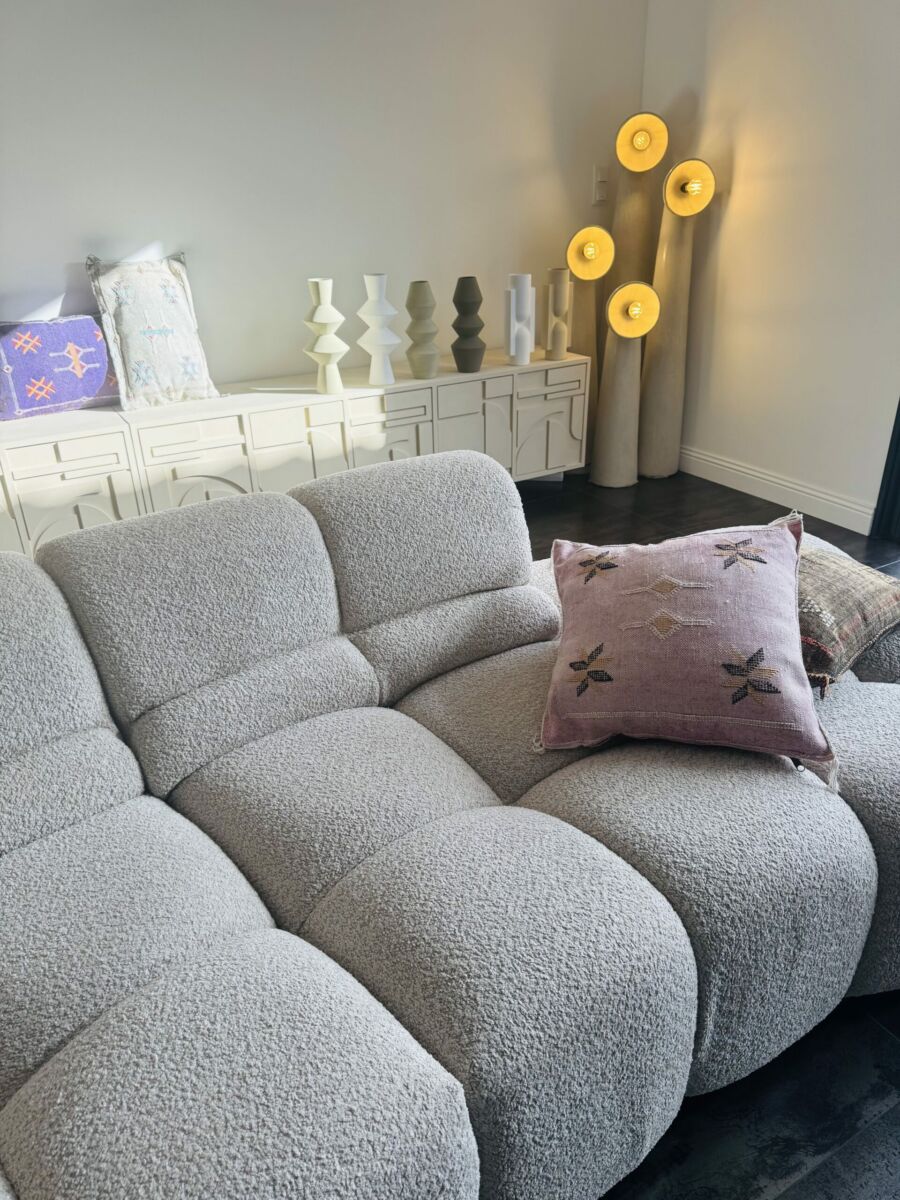
The sabra textile fits in with just the right touch when used as an accent rather than a dominant pattern. In a contemporary interior, it breaks up the monotony of smooth surfaces, bringing a tactile tension that avoids an overly tame effect.
On a sofa, it creates a subtle contrast between fluidity and structure. Paired with an artisan matte ceramic or a natural raphia pendant light, it reinforces the sense of natural materials without overloading the whole.
In a living room, a single well-placed cushion can be enough to visually structure the space. In a bedroom, it brings a light, almost quiet density. Balance is essential: well-dosed, it reveals. Too much presence, and the effect dilutes.
What to Know Before Buying
Sabra has a slightly elastic structure that keeps it from creasing — a real everyday advantage. Its moiré finish with bright reflections shifts subtly depending on the ambient light.
For care: some pieces tolerate a delicate wash at 40°C, others require hand spot-cleaning — fibers and water don't always mix well. Check the instructions for each piece. Note: sabra is designed for indoor use. Outdoors or exposed to prolonged sun, the colors and fibers deteriorate.
The Sabra Cushion at Maison Dar Anwar
Two formats, unique colorways, each piece tells
At Maison Dar Anwar, sabra is treated as a material in its own right, carrying a history and a territory. The selected pieces are part of this continuity: artisan textiles where fiber, hand, and light remain at the center.
Two formats available online, each in unique colorways with their own storytelling:
Les bleus sont partis à Paris
Cet été, tous nos coussins bleus sont partis d'un coup. « Tous les bleus », parce qu'aucun n'était identique : jamais le même tissage, jamais tout à fait la même couleur. Ensemble, ils sont allés illuminer d'un ciel bleu nuancé le canapé d'un appartement parisien.
The Selection
- Square Sabra Cushions — classic format, confident presence.
- Rectangular Sabra Cushions — lumbar format, a discreet and effective accent.
Each color is a piece in itself — antique sand, amethyst glow, powder pink, saffron. Shades from natural processes, never standardized.
Questions fréquentes sur le coussin sabra
Qu'est-ce que le sabra ?
Une fibre extraite des feuilles d'agave, une plante des régions arides du Maghreb. Une fois rouie, séchée et teinte, elle est tissée à la main. On l'appelle aussi soie de cactus ou soie végétale pour sa brillance.
Soie de cactus et sabra, c'est la même chose ?
Oui, ce sont deux noms pour la même fibre d'agave. Attention seulement aux imitations en viscose vendues sous ces noms.
Comment entretenir un coussin sabra ?
Dépoussiérez-le régulièrement et traitez les taches à la main, avec un chiffon humide et un savon doux. Certaines pièces supportent un lavage délicat à 40 °C : suivez les indications de chaque fiche.
Peut-on mettre un coussin sabra dehors ?
Non. Le soleil prolongé et l'humidité altèrent les couleurs et la fibre : il est fait pour l'intérieur.
Deux coussins de la même couleur sont-ils identiques ?
Jamais tout à fait. Le tissage main et la teinture artisanale font varier la nuance et la densité d'une pièce à l'autre.
Le rembourrage est-il fourni ?
Jusqu'à Noël, le rembourrage intérieur est offert avec chaque coussin sabra.
Some objects decorate. Others tell a story. Sabra does a bit of both — with that little extra touch of character that reminds us life has its cacti… and sometimes we find that out the prickly way. Ouch, ouch, ouch.
Jusqu'à Noël, le rembourrage est offert avec chaque coussin sabra : découvrez nos idées cadeaux de Noël.
Maison Dar Anwar
Genuine materials · free spirit