
Natural raphia pendant light: when light passes through material
A plant fiber, a woven gesture, a way of transforming a room's atmosphere.
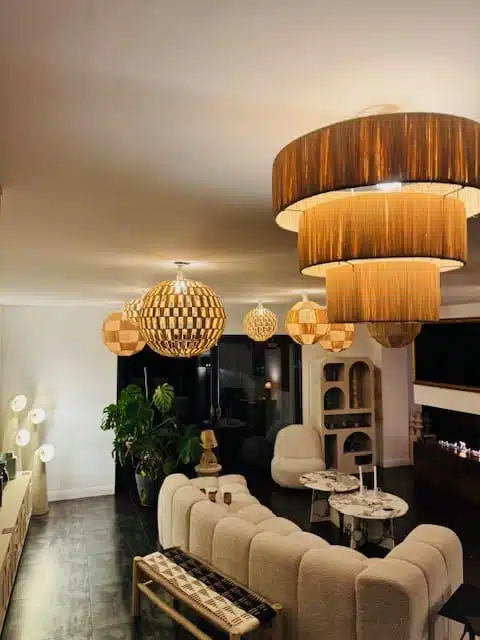
Before it's an object, the natural raphia pendant light is a presence. There's something alive in this material, almost mobile, that holds the light as much as it lets it through.
The weaving doesn't just produce a shape: it creates a vibration, a light density, a way of inhabiting the space without weighing it down. In a room, raphia turns light into texture. It softens, it filters, it adds relief.
And that's precisely where its interest begins: in this quiet dialogue between the hand, the fiber, and the atmosphere.
3 KEY TAKEAWAYS
- Natural raphia doesn't imitate anything — it embraces its rough edges, its wiry suppleness, its honest touch.
- A handmade pendant light gives off a vibrant light, never uniform — that's what makes it feel right.
- A single well-chosen piece is enough to transform the atmosphere of a space.
Raphia: A Material That Imitates Nothing
Natural plant fiber, unapologetically organic presence
Natural raphia has a presence that standardized materials can't reach. Made from a supple, resilient plant fiber, it retains something raw, slightly irregular, that recalls its organic origin. Its texture is neither smooth nor fixed: it catches the light, reveals nuances, and lets tonal variations show through that give the object depth right away.
What sets it apart is precisely this absence of effect. Raphia doesn't try to resemble anything else. It imitates neither rattan, nor textile, nor a well-finished synthetic material. It embraces its rough texture, its dry touch, its wiry suppleness. In an interior, it brings a rare quality: an honest, sensitive material, without artifice.

Raphia doesn't try to resemble anything else. It embraces its rough texture, its dry touch, its wiry suppleness.
Why Choose a Handmade Raphia Pendant Light
Irregularity as a Quality — Not a Flaw
Choosing a handmade raphia pendant light, it's not just about preferring one beautiful object over another. It's about choosing a piece whose making deliberately leaves room for the human gesture. Where industrial production seeks perfect repetition, handwork retains slight variations in weaving, thickness, and openness. These are what give the light its particular quality: less uniform, more vibrant, more alive.
A handcrafted light fixture rarely gives off neutral light. It shapes it. It draws softer shadows, creates relief, and lets the material show through even in the lighting itself. This irregularity isn't a flaw to correct; it's what makes the object feel right.
At Maison Dar Anwar, this dimension takes on even more meaning: all the raphia is woven by women. This detail isn't just a detail. It imprints each pendant light with a hand, an experience, a way of working that goes beyond mere production to become a form of transmission.
How to Incorporate a Raphia Pendant Light in an Interior
Height, pairings, material balance
A natural raphia pendant light finds its place in very different settings, provided its placement is thought through with precision. Above a dining table, it's usually hung fairly low to create a visual anchor point without blocking the view. In an entryway or bedroom, it can instead be placed higher to let the shape breathe and cast a more enveloping light.
It works particularly well in a contemporary interior when it introduces texture into a setting that's too smooth. With light concrete, white walls, or very understated lines, raphia brings a gentle tension, a tactile counterpoint that keeps things from feeling cold. In a warmer décor, it naturally pairs with washed linen, matte ceramic, raw wood, or stone.
The key is to pair it with other natural materials without falling into thematic overload. A single beautiful pendant light can be enough to transform a room. It catches the eye, but without dominating it. It structures the space while keeping a sense of lightness.
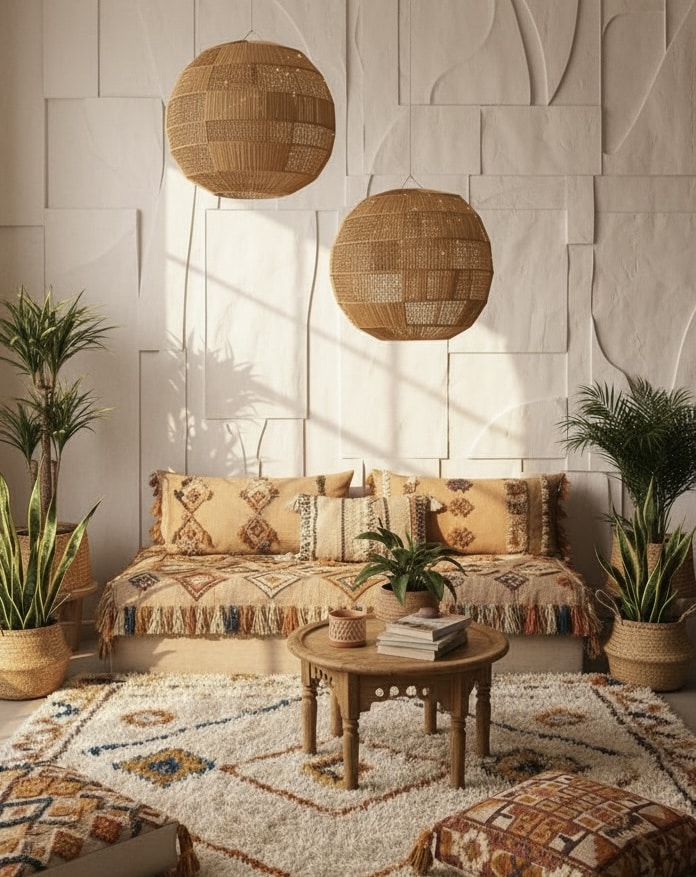
The Raphia Pendant Light at Maison Dar Anwar
A selection built around material and craft
At Maison Dar Anwar, the raphia pendant light is part of a selection built around material, craft, and balance of form. Each piece favors a quiet, sensitive presence in the space.
Among them, the pendant light Tiziri captures this approach well: a woven form that filters light without extinguishing it, giving the room a softer, more embodied feel.
Discover the Selection
Handmade artisan pendant lights, wall lights, and lighting — available in our online selection.
View artisan pendant lights & wall lightsChoosing a raphia pendant light isn't simply adding a point of light. It's deciding how a material will let light move through a room, calm it, give it a quiet density. Some objects decorate. Others truly change the atmosphere. That's often where the essential happens: in what you feel without it trying to draw attention to itself.
Maison Dar Anwar
Genuine materials · free spirit