
The perspective — Artisan decor
Incorporating a statement piece without overloading your interior.
A simple perspective for giving meaning to your artisan decor.
In many interiors, everything is decorative. So nothing really is anymore. The eye doesn't know where to settle — it slides, gets bored, moves on. It isn't a question of budget, or of taste. It's a question of hierarchy.
Incorporating a statement piece into your artisan decor, isn't about accumulating. It's about choosing what deserves to be there — and making room around it.
One simple question to ask right now:
If I could keep only one statement object in this room, which one would it be?
Fewer objects. More meaning.
What "statement" means
A statement piece doesn't have to be big, or spectacular. It's a piece that naturally draws the eye. That has a distinctive material or shape. That creates a visual anchor point — a place where the eye returns, and rests.
When several objects "want to be noticed" at the same time, they cancel each other out. The principle is simple:
In a room, only one thing should speak loudly.
Everything else supports it.
Concrete examples
- A colourful painting — against sober walls, it breathes.
- A raw table — with simple chairs, it truly exists.
- A an artisanal pendant light , used boldly — facing discreet furniture, it structures the entire room.
In each of these cases, it isn't the statement piece that changes. It's what you remove around it that reveals it.

A raw table is enough to structure an entire room — provided you give it space.
Let the material speak.
The artisan materials aren't smooth. They live with light, shadows, time. A handmade clay pottery changes with the time of day. A artisan raphia light fixture creates different shadows morning and evening. A travertine mirror is never quite the same as the one next to it.
These materials don't need to be "dressed up". They need space.
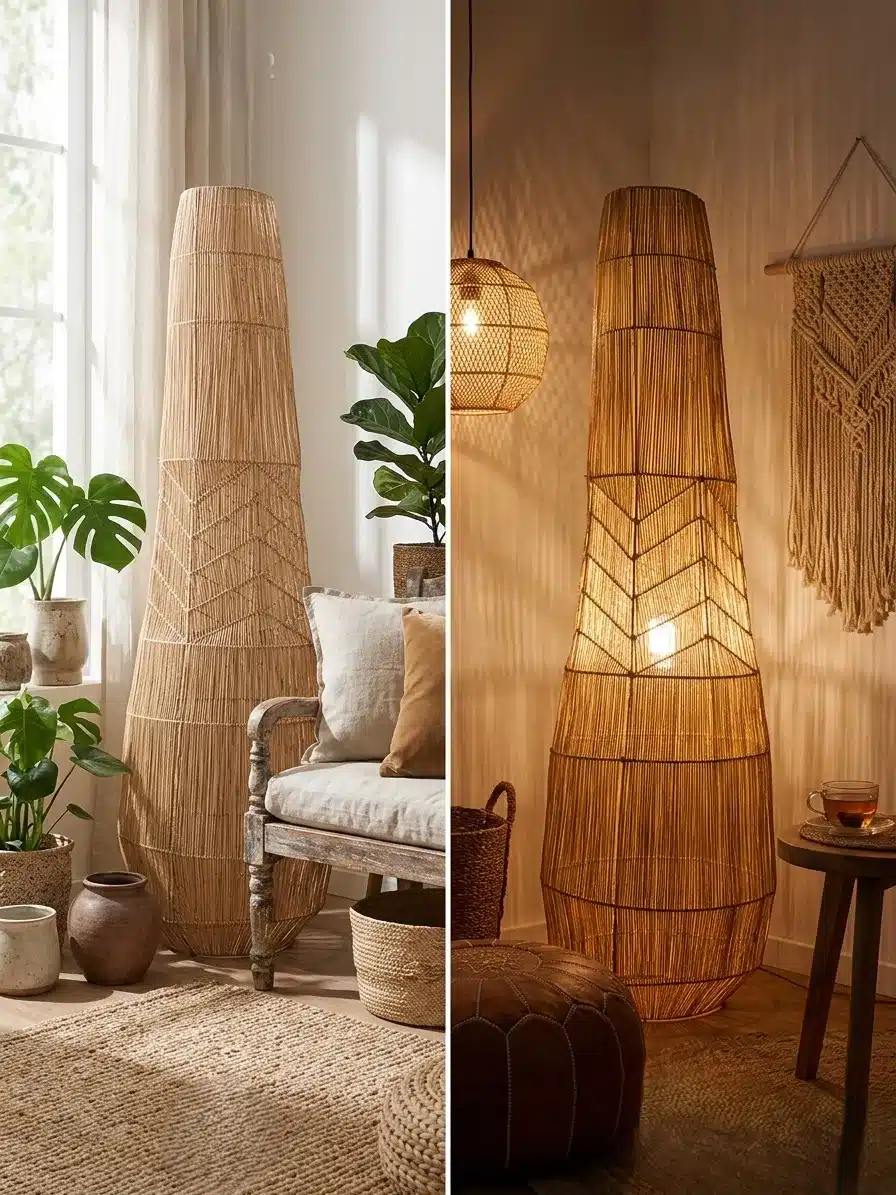
Hand-woven raphia — a living light, never perfectly regular.
The most common mistake
Adding accessories "to dress up" a room that's already complete. A raffia light fixture placed on a cluttered console, loses its impact. The same fixture alone, in an understated corner, structures an entire room.
The right instinct
Remove rather than add. Before looking for what's missing, look at what's cluttering. Material breathes when given room — and it repays that a hundredfold.
- Avoid surrounding an artisan piece with unnecessary decorative objects.
- Limit artificial contrasts — too many different materials cancel each other out.
- Accept imperfection as a quality, not as a flaw to correct.
Buy less. Choose better.
Choosing a statement piece for your artisan interior decor, is accepting that you'll forgo others. It's a conscious choice, sometimes a demanding one. But it's also the only one that lasts — because it rests on a conviction, not a trend.
An industrial object can be beautiful. But it carries no gesture. It keeps no trace of fire, of the hand, of time. It doesn't change with the light. It doesn't age — it wears out.
An artisan piece is not decoration.
It's a presence.
It doesn't dress a space — it inhabits it.
Two ways to go further
- Visit the showroom in La Rochelle — by appointment, to see and touch the materials. Something photos don't always show.
- Discover the online selection — ceramics, raphia, artisan mirrors, textiles. Delivered with care from La Rochelle.